Focus on Feed Additions Global Supply-13 Years in the Feed Additives Market.
Hotline+86 13821675082
Focus on Feed Additions Global Supply-13 Years in the Feed Additives Market.

 Hotline +86 13821675082
 Tel:+8613661236356
Email:sales@yeastpowderco.com
Add:Rm603 Central building, Xinmao Huayuan Park, Xiqing Dist., Tianjin China-300392
application
Yeast Culture (Selenium-Enriched is a composite-strain fermente...
Hotline+86 13821675082
Product Details
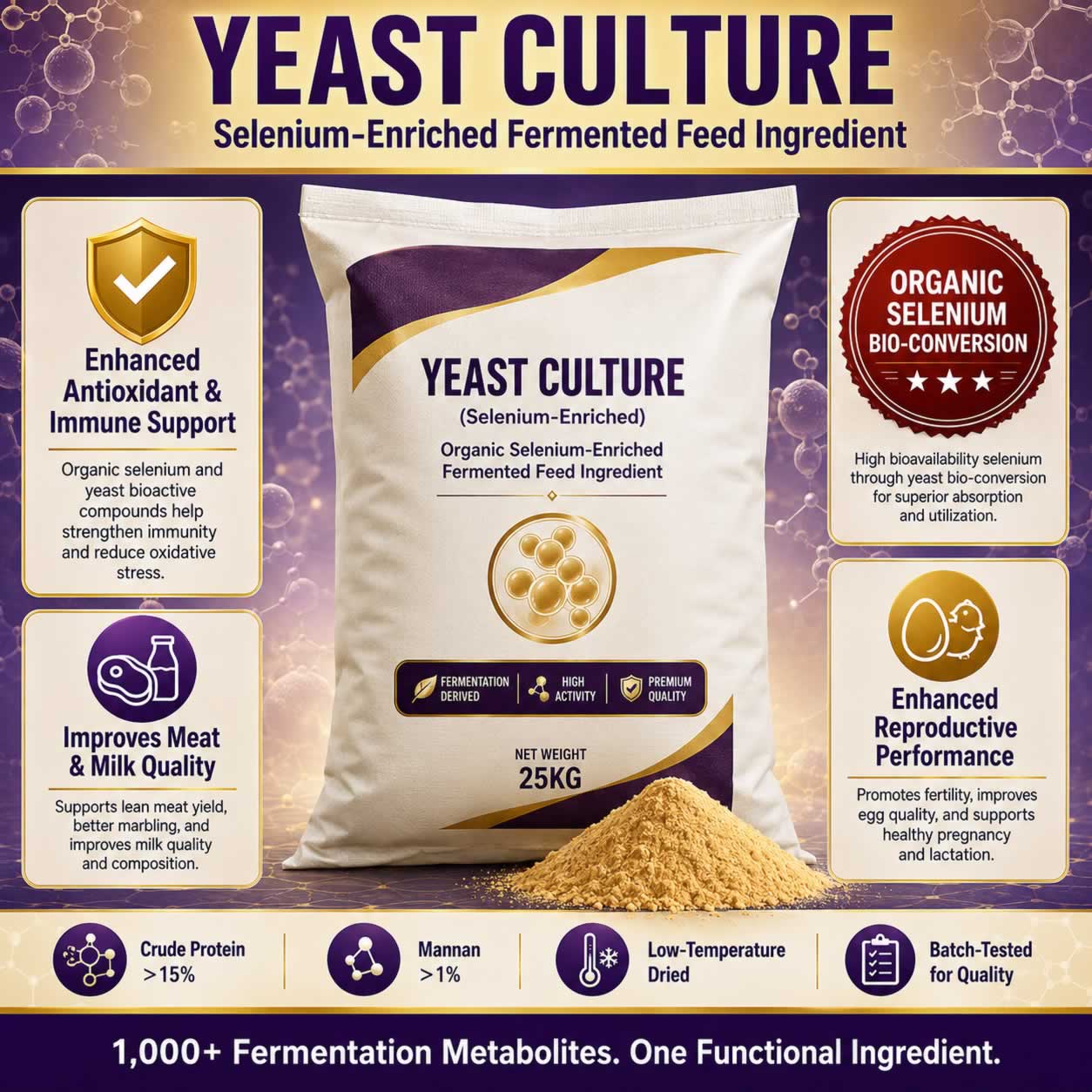
Yeast Culture (Selenium-Enriched) is a composite strain product built primarily on selenium-enriched yeast, developed with fermentation metabolism as its core process target. Through carefully screened composite strains that cooperate and interact throughout the fermentation process, the product generates over a thousand metabolic by-products, resulting in a functional fermented ingredient rich in organic selenium components and diverse bioactive metabolites.
The composite strains exhibit strong fermentation adaptability and tolerance, enabling the biological conversion of inorganic selenium in the fermentation substrate into an organic selenium source that is more readily absorbed and utilized by animals. The product undergoes a low-temperature drying process at the final stage, maximizing the retention of high levels of active substances — including organic acids, amino acids, vitamins, and mannan-oligosaccharides.
Organic Selenium — generated through biological conversion by composite strains, offering higher bioavailability and lower toxicity risk than inorganic selenium sources.
Mannan-oligosaccharides — typical value ~5.6%, supporting gut health and balanced intestinal microbiota.
Complex organic acid system — lactic, malic, and citric acid (total organic acids ~9.09%), helping regulate digestive tract pH and inhibit harmful bacteria.
Glutathione — ~2.02 mg/g, working synergistically with organic selenium to enhance antioxidant function.
Free amino acids and B-vitamin complex — supporting readily absorbable nutrition and overall metabolic function.
Enhances the body's antioxidant and immune performance
Improves meat quality and enhances milk quality
Improves animal reproductive performance
| Indicator | Guaranteed Value |
|---|---|
| Moisture content | ≤12.0% |
| Crude ash content | ≤10.0% |
| Crude protein | >15.0% |
| Mannan | >1.0% |
| Indicator | Value | Indicator | Value |
|---|---|---|---|
| Moisture | 7.4% | Total Dietary Fiber (TDF) | 19% |
| Dry matter | 92.6% | Acid Detergent Fiber (ADF) | 4.9% |
| Crude protein | 16.89% | Neutral Detergent Fiber (NDF) | 17.4% |
| Crude fat (Soxhlet method) | 2.9% | Starch (enzymatic method) | 35.8% |
| Crude fiber | 3.4% | pH | 4.68 |
| Crude ash | 7.1% | Yeast count | 6×10&sup6; CFU/g |
| Nitrogen-free extract | 63.01% |
| Indicator | Value | Indicator | Value |
|---|---|---|---|
| Total organic acids | 9.09% | Acid-soluble protein | 5.54% |
| Lactic acid | 4.86% | Glutathione | 2.02 mg/g |
| Malic acid | 4.04% | Amino acid nitrogen | 0.48% |
| Citric acid | 0.77% | Inositol | 29.5 mg/100g |
| Mannan | 5.6% | Inorganic ammonium | 0.8% |
| Reducing sugar | 4.2% | Inorganic nitrogen | 0.7% |
| Fructose | 0.78% | RNA content | 0.5% |
| Galactose | 52.2 mg/kg | Alkaline protease activity | 43.1 U/g |
| Amino Acid | Content | Amino Acid | Content |
|---|---|---|---|
| Free amino acids | 2.37% | Leucine | 1.24% |
| Aspartate | 1.45% | Tyrosine | 0.89% |
| Threonine | 0.54% | Phenylalanine | 1.73% |
| Serine | 0.67% | Lysine | 1.09% |
| Glycine | 0.72% | Histidine | 0.60% |
| Alanine | 1.06% | Arginine | 0.63% |
| Cystine | 0.89% | Proline | 1.17% |
| Valine | 0.99% | Total amino acids | 17.98% |
| Methionine | 0.26% | ||
| Isoleucine | 1.47% |
| Vitamin | Content |
|---|---|
| Vitamin B1 | 0.38 ppm |
| Vitamin B2 | 3.96 ppm |
| Niacin | 10.37 ppm |
| Pantothenic acid (B5) | 23.5 ppm |
| Vitamin B6 | 3.06 ppm |
| Biotin (B7) | 0.251 ppm |
| Folic acid (B9) | 0.29 ppm |
| Vitamin B12 | 0.057 ppm |
| Element | Content | Element | Content |
|---|---|---|---|
| Calcium | 0.36% | Aluminum | 97.5 mg/kg |
| Total phosphorus | 0.34% | Potassium | 1.74×10&sup4; mg/kg |
| Magnesium | 2710 mg/kg | Sodium | 5840 mg/kg |
| Iron | 170 mg/kg | Copper | 4.76 mg/kg |
| Manganese | 47.7 mg/kg | Chloride ion | 1.67% |
| Zinc | 47.8 mg/kg |
The values above are typical analysis values. Actual test results may vary slightly by batch; please refer to the factory test report for specific figures.
Swine Production: Suitable for breeding sow/boar diets to support reproductive performance, and finishing pig diets to improve meat quality.
Poultry Production: Suitable for breeder layer/broiler diets to improve hatching egg quality, and commercial layer diets for functional egg product development.
Ruminants (Cattle & Sheep): Suitable for lactating cow/ewe diets to improve milk quality, and breeding sires to support reproductive performance.
Aquaculture: Used in broodstock development and grow-out diets to improve stress resistance and reproductive performance.
Organic selenium bio-conversion with higher bioavailability
Complex bioactive component system — organic acids, amino acids, vitamins, mannan, and over a thousand metabolites
Low-temperature drying process preserving active substances
Three clearly defined benefits: antioxidant/immune support, meat and milk quality, reproductive performance
Universal across species — swine, poultry, ruminants, and aquaculture
Specific inclusion rates should be determined under the guidance of a professional feed nutritionist, based on species, growth stage, reproductive status, and overall diet formulation. Especially recommended for: breeding-stage diets, milk quality improvement during lactation, functional animal product development, and periods of elevated oxidative stress or immune pressure.
Q1: What's the difference between Yeast Culture (Selenium-Enriched) and standard yeast culture?
Standard yeast culture primarily provides nutritional metabolites, while the selenium-enriched version additionally enriches organic selenium through biological conversion — delivering both nutritional supply and selenium fortification.
Q2: What are the advantages of organic selenium over inorganic selenium sources such as sodium selenite?
Organic selenium generally offers higher bioavailability and greater safety, making it better suited for long-term, stable selenium supplementation.
Q3: Is the product suitable for all species at all growth stages?
The product is broadly applicable across species, but inclusion rates should be adjusted based on species, growth stage, and reproductive status. Consult a professional feed nutritionist for tailored recommendations.
Customized packaging options are available based on customer needs. Feed mills and farms interested in procurement or partnership are welcome to contact us for detailed product information, test reports, and application case studies.
The information and application recommendations in this document are provided for general reference. Actual results may vary depending on farming environment, animal species, and management practices. Please consult a qualified veterinarian or feed nutritionist for guidance specific to your operation.
Previous article:Selenium-Enriched Yeast Culture Industry Watch: Tightening Regulation, Market Expansion
Related Recommendations